It’s us against the World
In 2019, sports journalist Phil Hay wrote the following words about Leeds United football club.
An astonishing number of people despise Leeds United, or what Leeds United stand for. But this club was never made for them
These words are powerful, because they instantly divide every one of us into three clear tribes. They also provoke a strong call to arms. So why did he write that?
Brands are built like football clubs
Every organisation needs a clear sense of tribe and a strong call to arms. The more recognisable any brand is, the more people will buy into it. Brands are driven by creating a set of unique characteristics and building a passionate following. What can we learn from Leeds United?
One club, three tribes
The first of these tribes is made of the people who despise Leeds United. Many people dislike the club. For some people, it’s almost pathological. There will be people who don’t like Leeds United, because their loyalty is given to a rival club. Hating Leeds is part of supporting that rival. For some it’s because of the club’s 1970’s reputation as being ‘dirty Leeds’. The members of this tribe, cheer for the opposition. They celebrate a loss for Leeds United. They are proud to be the enemy.
The second tribe is for the people who feel that club was made for them. By labelling those who stand against Leeds, as a hostile opposition, Phil Hay’s words stand as a call to arms to the Leeds faithful. They speak of an enemy at the gates and of defending what’s dear to them. With Lord Kitchener’s pointing finger, they ask “Are you with Leeds or against us?”
The final tribe is those who don’t care either way. They are unmoved and unaffected, with no desire to take a side. Phil Hay’s words were not written for them. They don’t affect them. But they do affect everyone else.
How can you tell who is friend or foe?
There are several ways in which Leeds United fans can tell each other apart from the despisers and the disinterested. That is absolutely vital, so Leeds supporters know who is with them and who is not. Leeds fans have a distinct set of tribal behaviours and characteristics. When combined together, these traits form a unique tribal identity. What are they?
Club Name
Every organisation needs a clear tribal identity. A common name is a key part of it. By calling the team Leeds United, the club was clearly asking for unity amongst the people of Leeds.
Club Home
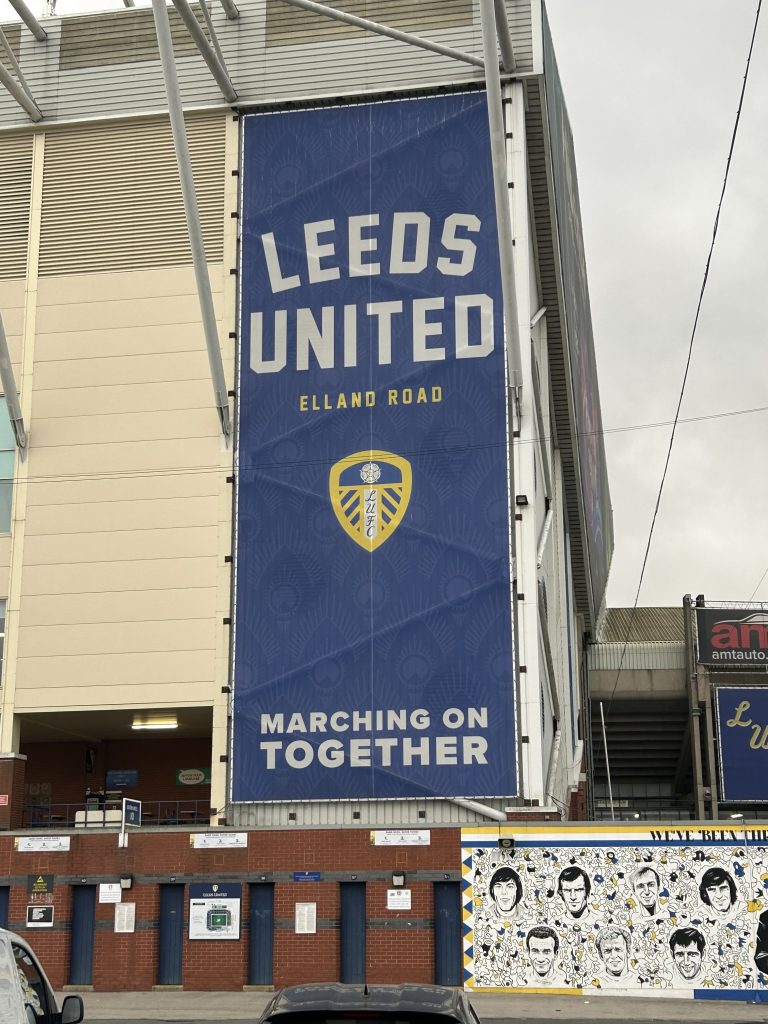
Leeds play their home games at Elland Road football stadium in the city. The Elland Road home crowd has a reputation for being extremely loud, extremely passionate and very hostile towards the opposition. There’s a siege mentality, calling for its supporters to raise their voices and defend their sacred ground. Elland Road is a place of pilgrimage for Leeds supporters and a daunting place for other supporters to visit.
Common Dress
Leeds fans wear replica shirts, t-shirts, hoodies and jackets with the Leeds club badge on them, right over their heart. By openly showing off your white, yellow and blue Leeds United colours, you are declaring your allegiance to the club. A fan of another team definitely wouldn’t wear clothing with the Leeds United badge on it.
Common Saying
The Leeds United fans have a saying, which unites them.
All Leeds aren’t we
This phrase (or the shorthand ‘ALAW’) is said between supporters, to recognise each other’s commitment to the cause. Come rain or shine, come victory or loss, they are all Leeds together.
It’s a form of tribal greeting and as such it requires a positive response. Getting one is reassuring and bonding. Discovering that the other person you’ve addressed doesn’t feel all Leeds, is an immediate red flag.
This phrase is sporting version of ‘Who goes there?’ or ‘Friend or foe?’
Club song
Even more well known is the Leeds United club song ‘Marching on Together’. First released in 1972, it is still played before every home match. This tribal song speaks of unity and has stood the test of time. ‘Marching on Together’ includes the lyrics:
We are so proud, we shout it out loud. We love you Leeds, Leeds, Leeds.
If you know them and you sing them, then you are with Leeds and not against them.
Common gesture
When Leeds supporters sing Marching on Together, they have a form of salute they use, whenever they get to the lyrics “Leeds, Leeds, Leeds”. It’s three fist bumps on the club badge, right above their heart, on their replica shirt, jacket or hoody. It’s so powerful, it’s even used as a stand alone chant.
When the players want to send a message of commitment to the fans, they mirror the same salute back towards them. Three quick fist bumps on the club badge after they’ve scored is a way of saying All Leeds Aren’t We, without actually saying a thing.
If you walked down the street and saw someone wearing a Leeds shirt, you could do three quick fist bumps and they would know instantly that you were Leeds too.
A clear tribal identity
When you need your supporters to turn up in great numbers, to cheer loudly and passionately and to be dedicated to your team, you need to create a common tribal identity. You also need a clear call to arms to your supporters. Leeds United has done these things very successfully. Their support is legendary for its intensity. Every brand wants that, doesn’t it?
Former Leeds United Manager was asked what the Leeds fans are like, compared to other clubs. He quickly replied
It’s like a bloody religion there!
Over many years, Leeds United has built a clear sense of tribal identity. That sets them apart from many other teams. Their supporters know what being Leeds is. So do their opponents. Leeds United was made for the Leeds fans. Are you with Leeds or against them?